A neural brain embed gives close immediate discourse
Stephen Peddling, a British physicist and ostensibly the foremost popular man enduring from catastrophic horizontal sclerosis (ALS), communicated with the world employing a sensor introduced in his glasses.
That sensor utilized minor movements of a single muscle in his cheek to choose characters on a screen. Once he written a full sentence at a rate of generally one word per diminutive, the content was synthesized into discourse by a DEC talk TC01 synthesizer, which gave him his notorious, automated voice.
But a part has changed since Selling kicked the bucket in 2018. Later brain-computer-interface (BCI) gadgets have made it conceivable to decipher neural movement straightforwardly into content and indeed discourse.
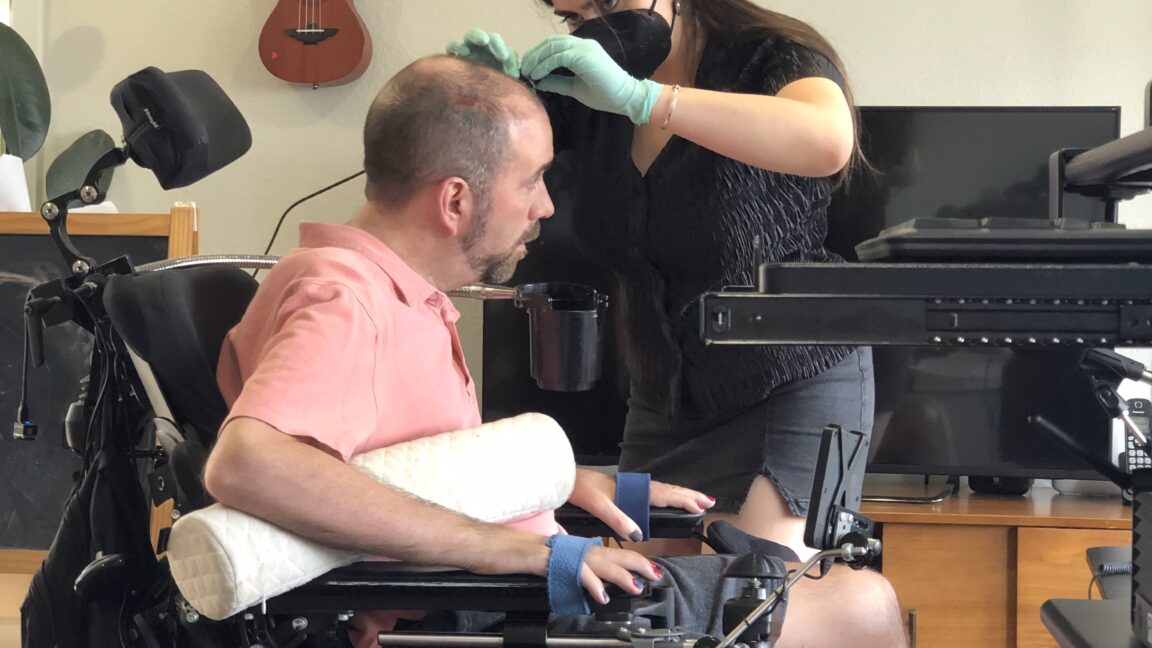
Shockingly, these frameworks had critical idleness, regularly constraining the client to a predefined lexicon, and they did not handle subtleties of talked dialect like pitch or prosody. Presently, a group of researchers at the College of California, Davis has built a neural prosthesis that can instantly interpret brain signals into sounds€”phonemes and words. It may be the primary genuine step we have taken toward a completely advanced vocal tract.
Content informing “Our fundamental objective is making a adaptable discourse neuroscientists that empowers a quiet with loss of motion to talk as smoothly as conceivable, overseeing their possess cadence, and be more expressive by letting them balance their intonation,†says Maitreya Karaganda, a neurocysticercoses analyst at UC Davis who driven the ponder.
Creating a prosthesis ticking all these boxes was an gigantic challenge since it meant Wairagkar’s group had to fathom about all the issues BI-based communication solutions have confronted within the past. And they had very a part of issues. The primary issue was moving past text—most fruitful neural prostheses created so distant have interpreted brain signals into text—the words a understanding with an embedded prosthesis needed to say essentially showed up on a screen. Francis R.
Wilmette led a group at Stanford College that accomplished brain-to-text interpretation with around a 25 percent blunder rate. “When a lady with ALS was attempting to talk, they seem translate the words. Three out of four words were adjust.
That was super energizing but not sufficient for every day communication,†says Sergei Stravinsky, a neuroscientist at UC Davis and a senior creator of the consider. Delays and lexicons One year after the Stanford work, in 2024, Stravinsky€™s group distributed its claim inquire about on a brain-to-text framework that bumped the precision to 97.5 percent. “Almost each word was rectify, but communicating over content can be limiting, right?†Stavisky said. “Sometimes you want to utilize your voice. It permits you to form contributes,
it makes it less likely other individuals hinder you—you can sing, you'll utilize words that aren’t within the dictionary.†But the foremost common approach to producing discourse depended on synthesizing it from content, which driven straight into another issue with BCI frameworks: exceptionally tall idleness. In about all BCI discourse helps, sentences showed up on a screen after a noteworthy delay, longafter the quiet wrapped up hanging the words together in their intellect.
The discourse amalgamation portion as a rule happened after the content was ready, which caused indeed more delay. Brain-to-text arrangements too endured from a constrained lexicon. The most recent framework of this kind supported a lexicon of generally 1,300 words.
After you attempted to talk a distinctive dialect, utilize more expound lexicon, or indeed say the bizarre title of a café fair around the corner, the frameworks fizzled. So, Wairagkar planned her prosthesis to decipher brain signals into sounds, not words—and do it in genuine time.
Extricating sound The understanding who concurred to take part in Wairagkar’s consider was codenamed T15 and was a 46-year-old man enduring from ALS. “He is seriously paralyzed and when he tries to talk, he is exceptionally troublesome to get it. I’ve known him for a few a long time, and when he talks, I get it possibly 5 percent of what he’s saying,†says David M. Brandman, a neurosurgeon and co-author of the consider. Some time recently working with the UC Davis group, T15 communicated employing a gyroscopic head mouse to control a cursor on a computer screen. To utilize an early adaptation of Stravinsky€™s brain-to-text framework, the quiet had 256 microelectrodes embedded into his ventral precentral gyrus, an range of the brain capable for controlling vocal tract muscles.
For the modern brain-to-speech framework, Wairagkar and her colleagues depended on the same 256 terminals. “We recorded neural exercises from single neurons, which is the most noteworthy resolution of data we are able get from our brain,†Wairagkar says. The flag enrolled by the cathodes was at that point sent to an AI algorithm called a neural decoder that deciphered those signals and extricated discourse highlights such as pitch or voicing. Within the following step,
these highlights were nourished into a vocoder, a speech synthesizing calculation outlined to sound just like the voice that T15 had when he was still able to talk ordinarily. The complete framework worked with inactivity down to around 10 milliseconds—the change of brain signals into sounds was viably momentary. Since
Wairagkar’s neural prosthesis changed over brain signals into sounds, it didn’t come with a constrained choice of upheld words. The understanding might say anything he needed, counting pseudo-words that weren’t in a word reference and adds like “um,†“hmm,†or “uh.†Since the framework was touchy to highlights like pitch or prosody, he seem moreover vocalize questions saying the final word in a sentence with a somewhat higher pitch and even sing a brief melody.
But Wairagkar’s prosthesis had its limits. Coherent changes To test the prosthesis€™s execution, Wairagkar’s group to begin with inquired human audience members to coordinate a recording of a few synthesized discourse by the T15 persistent with one transcript from a set of six candidate sentences of comparative length. Here, the comes about were totally culminate, with the framework accomplishing 100 percent coherent.
Tags:
Neural brain implant technology
Brain-computer interface (BCI) speech
Instantaneous speech generation
Neural implant for speech restoration
Speech synthesis brain implant
Neuroprosthetics speech
Brain-to-text technology
Speech brain interface
Neural implants for paralysis
BCI speech communication
Direct brain speech control
Neural implants for disabled communication
Neurotechnology advancements in speech
Real-time speech translation implant
Brainwave speech decoding
Artificial speech generation
BCI for speech impairment
Neural interface speech therapy
Brain interface technology for speech
Neuroprosthetic speech device
https://www.aitechgadget.com/2025/06/neural-brain-implant-technology-speech.html



0 Comments